
Hardscape & slope
Retaining walls that hold North Georgia slopes
Modular block and natural-stone walls that terrace a steep lot, reclaim usable yard, and stop erosion on red clay. Built with the drainage and base engineering that decides whether a wall lasts thirty years or fails in three.
Quick answer
A retaining wall holds back soil that would otherwise slide, wash or slump downhill, turning a slope you can't use into level, planted, walkable ground and stopping erosion on Cherokee County's red clay. What makes a wall last isn't the block you see; it's the base, the gravel backfill and the drainage behind it. Complete Horticulture builds modular block, timber and natural-boulder walls across Canton and North Georgia, and after a free on-site visit you get a written quote scoped to your slope, soil and wall height.
What does a retaining wall actually do?
A retaining wall holds back soil that would otherwise slide, wash or slump downhill, turning a slope you can't use into level, planted, walkable ground. On the sloped lots that define North Georgia, a good wall does three jobs at once: it creates usable space, it controls erosion, and it protects everything downhill from the water and soil that a bare slope keeps moving.
The part you see is the least of it. What makes a wall stand is behind the face, proper base, backfill, geogrid reinforcement where the height calls for it, and a drainage system that gets water out before it can push the wall over. We build modular concrete block, timber and natural-boulder walls, and we design the terracing so multiple walls work together to tame a slope gracefully rather than fighting it with one massive structure. Where a slope is genuinely wet, the wall is only half the fix, it works hand in hand with grading & drainage that keeps water from ever loading the wall.
What we build
Walls for every grade problem.
Modular block walls
Engineered segmental block, clean, consistent and cost-effective, with reinforcement built in for taller walls.
Natural stone walls
Boulder and fieldstone walls with a timeless, one-of-a-kind look that ties into the landscape.
Terracing
A series of lower walls that step down a steep lot into flat, plantable, usable levels.
Drainage systems
Gravel backfill, filter fabric and drain pipe behind every wall, the reason it stays standing.
Seat & garden walls
Lower walls that raise beds, define a patio edge or double as built-in seating.
Erosion control
Walls paired with grading and planting to stop a clay slope from washing into the yard or driveway.
The difference is drainage
A wall doesn't fail from the front. It fails from behind.
When you see a retaining wall bulging or leaning, the cause is almost always water trapped behind it. Red clay is the worst possible backfill, it holds water, gets heavy, and pushes with enormous force. A wall built without proper drainage is on a countdown. One built with gravel backfill, filter fabric and a drain that carries water away can outlast the house.
Because we're horticulturists, we also plan what happens on top of and below the wall, the plantings that knit the soil together, the grading that keeps water from ever loading the wall in the first place, and the terrace levels that become genuinely usable garden space.
Meet Warren
How we build a wall
Right from the footing up.
Assess the slope
A free site visit to read the grade, soil and where water is coming from, then a plan and written quote.
Excavate & base
Cut the bench, lay and compact a leveling base, the foundation that keeps courses true.
Build & drain
Set courses with gravel backfill, filter fabric, drain pipe and geogrid reinforcement as needed.
Cap & plant
Finish caps, restore grade, and plant the terraces so the slope is stable and beautiful.
Built for North Georgia
Why walls matter more on clay slopes.
Cherokee County and its neighbors are built on hills of heavy red clay. Clay sheds water fast on the surface and holds it stubbornly below, a combination that erodes bare slopes and overloads badly built walls. Get the wall and the water right, and a slope that was wasted becomes the best part of the yard.
- Gravel backfill and drainage instead of water-holding clay behind the wall
- Terracing to break a steep lot into stable, usable levels
- Geogrid reinforcement engineered to wall height and soil load
- Deep-rooted, adapted plantings that lock the slope together long term
Materials
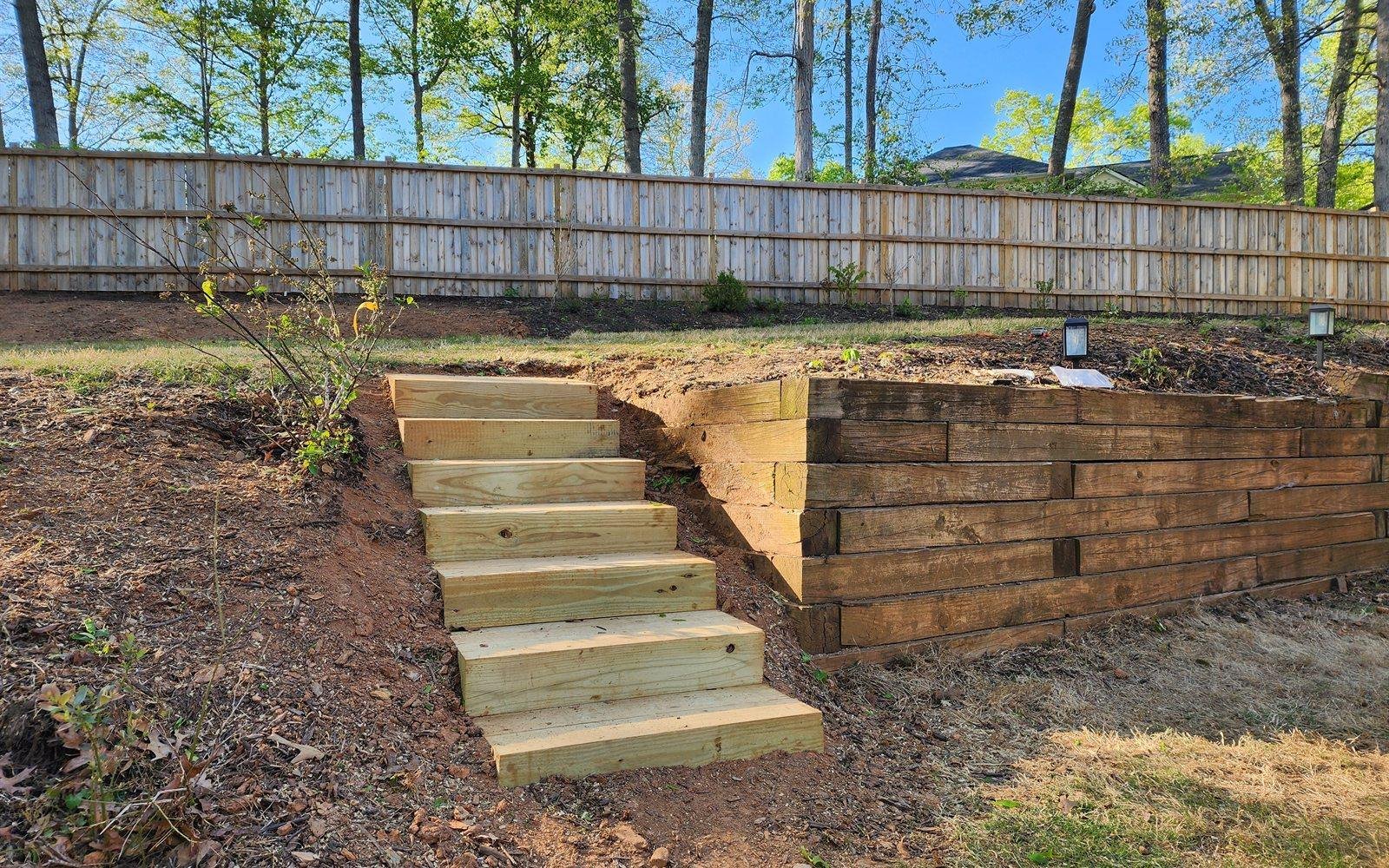
Modular block, timber or natural boulder, which wall is right?
The best material depends on the wall's height, the look you want, and how long you need it to last. All three can be built well, but on a red-clay slope, the material matters far less than the base and drainage behind it. Here's the honest comparison.
Modular (segmental) block
Pros: engineered and consistent, can be reinforced with geogrid to significant heights, wide color range, strong value. Cons: a manufactured look some homeowners find less natural. Best for: most structural walls, taller retained slopes, terracing, and any wall doing real load-bearing work. This is the workhorse for North Georgia yards.
Timber
Pros: lower upfront cost, warm rustic look, quick to build for low walls and raised beds. Cons: the shortest lifespan of the three, even treated timber eventually rots and fails in our humid climate, and it's hard to reinforce for height. Best for: short, non-critical walls, garden terraces and budget-sensitive projects where you accept replacing it down the road.
Natural boulder & fieldstone
Pros: the premium, timeless look; boulders are heavy enough to be very stable, and stone reads as permanent in a wooded setting. Cons: the most expensive in material and skilled labor; large boulders need machine access. Best for: feature walls, naturalistic landscapes and acreage lots where the stone belongs, common on the rural properties around Ball Ground.
The part that actually decides whether a wall lasts: base & drainage
Whatever the face is made of, a wall on a North Georgia clay slope lives or dies on two things you'll never see. First, a proper leveling base, a compacted, well-drained footing that keeps the first course true, because every course above rides on it. Second, drainage behind the wall: gravel backfill, filter fabric and a perforated drain pipe that carries water out. Red clay is the worst possible backfill, it holds water, gets heavy, and pushes with enormous force, especially when it freezes and thaws. A wall built with clay packed against its back is on a countdown; a wall built to drain can outlast the house. This is exactly why we tie every wall into a drainage plan and, where the slope needs to be climbed, into steps and stairways that share the same footing strategy.
What affects the cost of a retaining wall?
Walls are priced by more than length. A low garden wall and a tall structural wall of the same run are very different projects, because the taller wall needs deeper base, reinforcement and often engineering. Here's what moves the number:
- Height & length, total square footage of wall face; taller walls need geogrid reinforcement and, past a threshold, an engineer's design.
- Material, timber is cheapest upfront, modular block sits in the middle with the best value-to-life ratio, natural boulder is the premium.
- Drainage & excavation, the gravel, fabric, pipe and dig behind the wall are non-negotiable and a real share of the cost.
- Site access, whether machines can reach the work, or boulders and spoil have to be moved by hand.
- Terracing, several stepped walls to tame a steep lot cost more than one, but are often the only stable, usable solution.
We don't quote walls sight-unseen, because the slope and the water are what set the scope. After a free on-site assessment you get a detailed, itemized written quote built to your wall, not a per-foot guess.
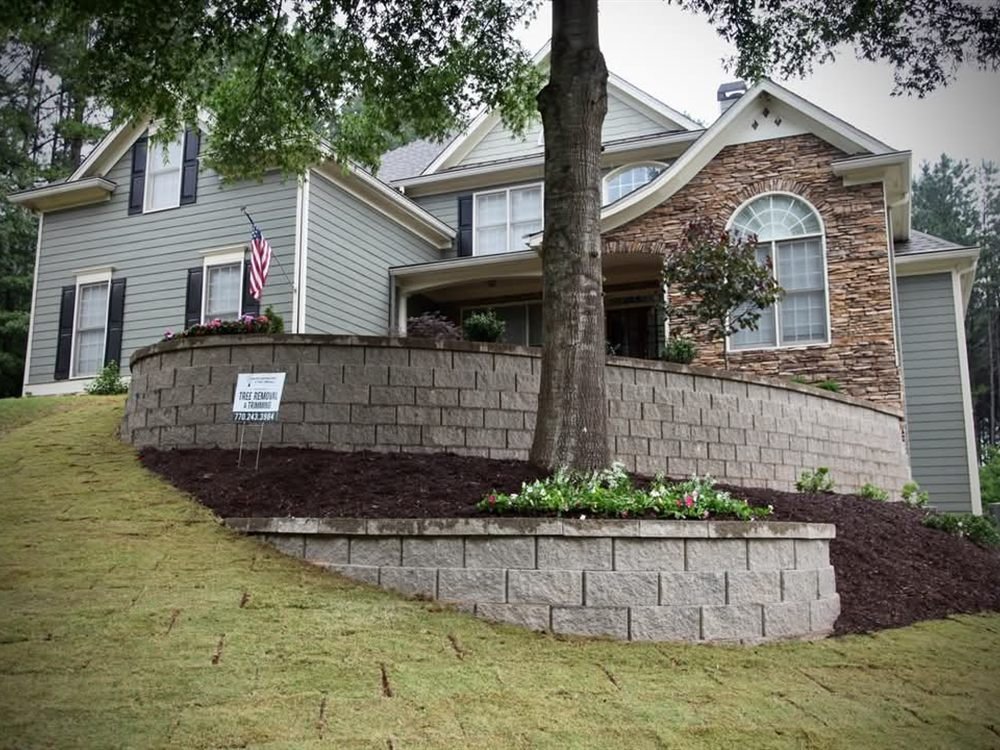
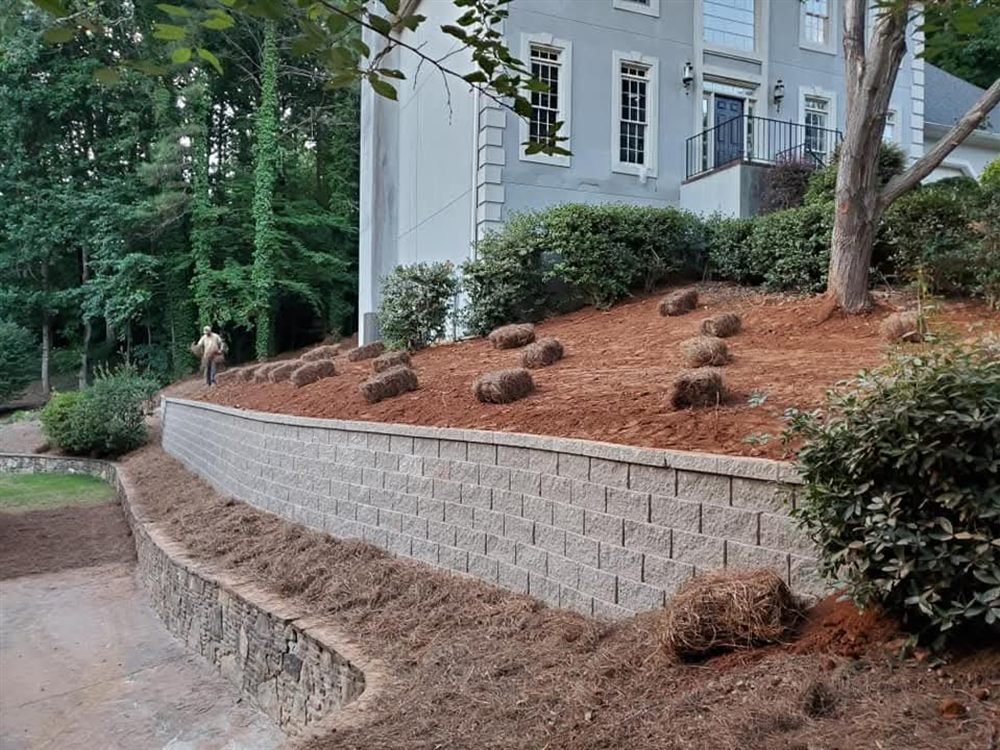
Selected work
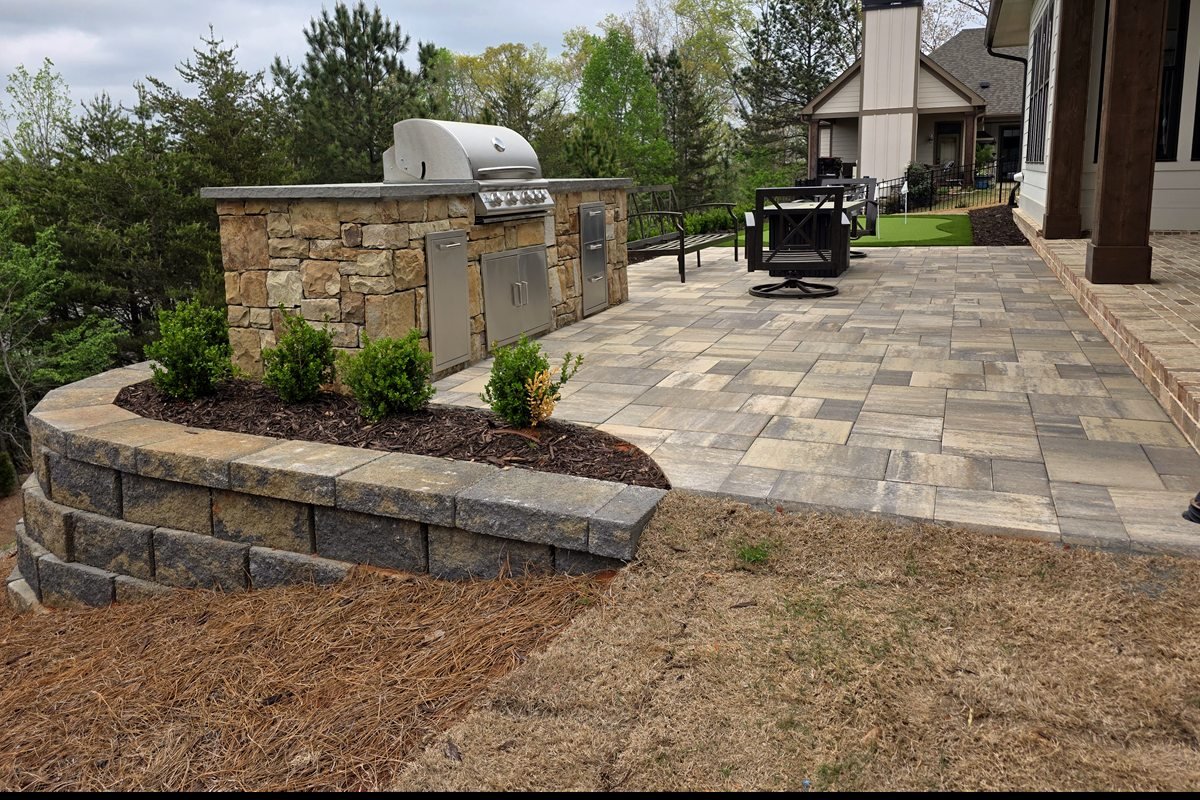
Walls, built.
Retaining wall FAQ
Questions homeowners ask.
Modular block, timber or natural boulder, which is best?
None is universally best. Engineered modular block is precise, can be reinforced to significant heights, and the best value-to-life ratio for structural walls. Timber is cheaper upfront but the shortest-lived in our humid climate. Natural boulder is the premium, timeless look for a wooded setting. We match the material to the wall's job, your home's style, and the budget.
Why do retaining walls fail on North Georgia clay?
Trapped water, almost every time. Red clay holds water and pushes hard against a wall, and freeze-thaw makes it worse. A wall built with clay backfill and no drainage leans and bulges within a few years. The fix is gravel backfill, filter fabric and a working drain pipe behind the wall on a solid compacted base, which is how we build every one.
Do tall retaining walls need engineering or a permit?
Often, yes. Many local jurisdictions require an engineer's design and a permit once a wall exceeds a certain height (commonly around four feet of exposed face). We'll tell you what your project needs and build the wall to code.
Can a retaining wall fix erosion and standing water?
A wall is part of the fix, not all of it. Terracing a slope with walls slows and holds the soil, but you also have to send the water somewhere. We pair walls with grading and drainage, swales, dry creek beds and drain lines, so the slope stops washing and the wall never gets overloaded in the first place.
Can you terrace a steep backyard into usable levels?
Yes, terracing is often the best answer for a steep lot. A series of lower walls steps the grade into flat, plantable levels that are more stable and usually more affordable and better-looking than one tall wall. We can add steps and stairways between levels so the whole slope becomes usable garden rather than wasted hillside.
Do you build retaining walls in Ball Ground and Cherokee County?
Yes. We build walls across Cherokee County and North Georgia, including Ball Ground, Canton, Woodstock and beyond. The foothill and acreage lots up here are exactly where boulder and terraced walls shine. See our full service area.